
Consider An Spherical Cow Pdf Download
 View and Download NEC NEAX 2000 IVS user manual online. NEAX 2000 IVS Software pdf manual download. Also for: Matworx 32. For how to use MATWorX, refer to “MATWorX User Guide”. For PBX hardware, refer to “NEAX 2000 IPS System Manual”. For operation of Key FD, refer to “Key FD Operation Guide”. Terms In This Manual In this manual, the following PBX system is designated as “PBX” usually. NEAX 2000 IPS INTERNET PROTOCOL SERVER. NEAX IPS. We have recently inherited to mantain NEAX 2000 IPS with NEAX Mail AD40 Voicemail unit. Where can I get and Download the MATWorX software to remotely access the MATWorX Studio software - NEC: PBX solutions - Tek-Tips.
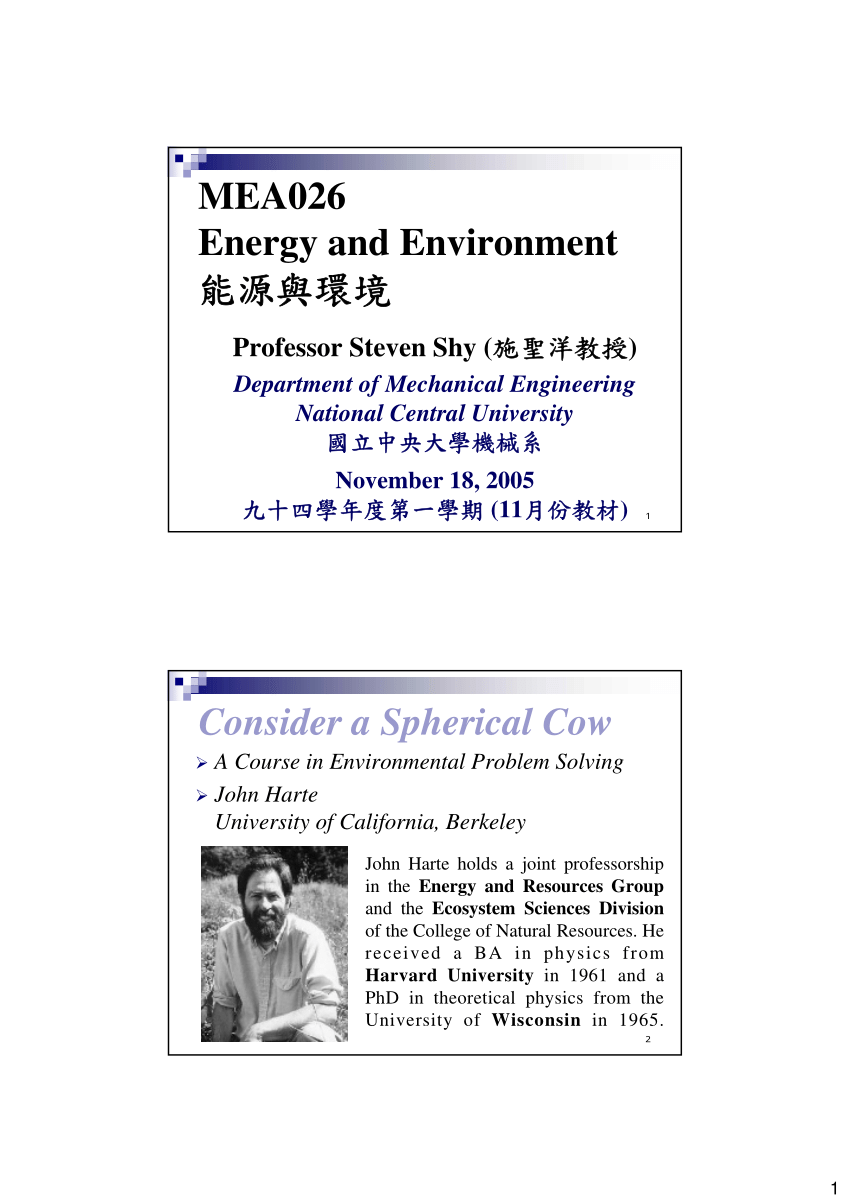
The spherical cow comes from a story that is often told in physics classes. A farmer is having trouble getting enough milk from his cows, and consults a physicist. After pondering the problem for a while, the physicist begins his analysis with the statement, “Assume a spherical cow.” Download: Download high-res image (59KB).
Author by: John HarteLanguage: enPublisher by: University Science BooksFormat Available: PDF, ePub, MobiTotal Read: 17Total Download: 304File Size: 44,9 MbDescription: Challenging, real-world situations and worked-out solutions provide the means both for gaining insights into the process of problem solving and for thinking quantitatively and creatively about such environmental concerns as energy and water resources, food production, indoor air pollution, acid rain, and human influences on climate. Author by: John HarteLanguage: enPublisher by: University Science BooksFormat Available: PDF, ePub, MobiTotal Read: 79Total Download: 596File Size: 42,5 MbDescription: Following in the tradition of Consider a Spherical Cow, the Cylindrical Cow will help students achieve a whole new level of environmental modeling and problem solving.
Featuring a new core set of 25 fully worked-out problems, this book uses real problems in environmental science rather than relying on the more traditional 'cookbook' problems found in textbooks. It is organized according to five thematic sections on probability, optimization, scaling, differential equations, and stability and feedback.
Each section begins with a general treatment of the relevant mathematical concepts, and concludes with a range of homework exercises to help students sharpen their modeling skills. Like its predecessor, this book will empower students with the mathematical skills needed to cut through the complexity of real-world problems. Author by: Joseph E. GortychLanguage: enPublisher by: CRC PressFormat Available: PDF, ePub, MobiTotal Read: 65Total Download: 230File Size: 40,7 MbDescription: Get Critical Insight into the Modern Patenting Scene We are now living in the 'IP Era of the Information Age' where technology businesses are placing increasing emphasis on intellectual property (IP) as a way to add to their bottom lines. As a consequence, those working in a technology business or organization will inevitably be thrust into working with IP in one or more of its various forms.
This increasing emphasis on IP matters requires technology workers to have at least a basic practical understanding of IP, particularly patents, so that they can effectively participate in their organizations’ IP and patenting efforts. Consider a Spherical Patent: IP and Patenting in Technology Business provides an unconventional and unvarnished examination of patents and the reality of how they are used and abused in technology business. The book starts with an overview of patents and how the patenting universe has become so complex, and warns of the danger of making 'spherical,' simplifying assumptions about patents and patent-related matters.
It then takes a look at the cast of characters in the modern patenting world and the roles they play at the 'IP Bazaar.' The book goes on to explain the increasing emphasis in today’s modern IP world of leveraging patents in large collections of patents called 'portfolios.' The author describes how the fractal nature of innovation allows for the exponential growth of patents to densely pack an 'IP space,' including how this packing can exceed its normal limits and the adverse consequences.
He also explores the evolution and importance of core to improvement to commercialization patents. A modern view of patents based on 'quantum patent mechanics' explains some of the mysterious patent-related phenomena that are otherwise inexplicable using 'classical patent mechanics.' Using examples of actual patents and patent portfolios of real technology businesses, the author discusses how patenting strategies are defined based on 'central organizing principles' behind why patents are being pursued.
He describes the operational realities of running an internal patenting system as well as how to avoid the prevalent trap of accepting a high degree of disorder (entropy) in the business’s patenting system. He also takes a close look at other problematic areas, such as the use and abuse of provisional patent applications and how 'no shame claims' can be issued by the patent office and the havoc they can create. Author by: Russell K. HobbieLanguage: enPublisher by: Springer Science & Business MediaFormat Available: PDF, ePub, MobiTotal Read: 39Total Download: 514File Size: 55,9 MbDescription: This text bridges the gap between introductory physics and its application to the life sciences.
It is intended for advanced undergraduates and beginning graduate students. The Fourth Edition is updated to include new findings, discussion of stochastic processes and expanded coverage of anatomy and biology. The text includes many problems to test the student's understanding, and chapters include useful bibliographies for further reading.
Its minimal prerequisites and wide coverage make it ideal for self-study. The fourth edition is updated throughout to reflect new developments. Author by: Daniel M. KammenLanguage: enPublisher by: Princeton University PressFormat Available: PDF, ePub, MobiTotal Read: 38Total Download: 577File Size: 51,9 MbDescription: The authors draw together, organize, and seek to unify previously disparate theories and methodologies connected with risk analysis for health, environmental, and technological problems. They also provide a rich variety of case studies and worked problems, meeting the growing need for an up-to-date book suitable for teaching and individual learning.
Pinnacle 52 for windows xp free. The specific problems addressed in the book include order-of-magnitude estimation, dose-response calculations, exposure assessment, extrapolations and forecasts based on experimental or natural data, modeling and the problems of complexity in models, fault-tree analysis, managing and estimating uncertainty, and social theories of risk and risk communication. The authors cover basic and intermediate statistics, as well as Monte Carlo methods, Bayesian analysis, and various techniques of uncertainty and forecast evaluation.
Author by: Jordan EllenbergLanguage: enPublisher by: PenguinFormat Available: PDF, ePub, MobiTotal Read: 49Total Download: 638File Size: 55,9 MbDescription: The Freakonomics of math—a math-world superstar unveils the hidden beauty and logic of the world and puts its power in our hands The math we learn in school can seem like a dull set of rules, laid down by the ancients and not to be questioned. In How Not to Be Wrong, Jordan Ellenberg shows us how terribly limiting this view is: Math isn’t confined to abstract incidents that never occur in real life, but rather touches everything we do—the whole world is shot through with it. Math allows us to see the hidden structures underneath the messy and chaotic surface of our world. It’s a science of not being wrong, hammered out by centuries of hard work and argument.
Armed with the tools of mathematics, we can see through to the true meaning of information we take for granted: How early should you get to the airport? What does “public opinion” really represent? Why do tall parents have shorter children? Who really won Florida in 2000? And how likely are you, really, to develop cancer?
How Not to Be Wrong presents the surprising revelations behind all of these questions and many more, using the mathematician’s method of analyzing life and exposing the hard-won insights of the academic community to the layman—minus the jargon. Ellenberg chases mathematical threads through a vast range of time and space, from the everyday to the cosmic, encountering, among other things, baseball, Reaganomics, daring lottery schemes, Voltaire, the replicability crisis in psychology, Italian Renaissance painting, artificial languages, the development of non-Euclidean geometry, the coming obesity apocalypse, Antonin Scalia’s views on crime and punishment, the psychology of slime molds, what Facebook can and can’t figure out about you, and the existence of God.
Ellenberg pulls from history as well as from the latest theoretical developments to provide those not trained in math with the knowledge they need. Math, as Ellenberg says, is “an atomic-powered prosthesis that you attach to your common sense, vastly multiplying its reach and strength.” With the tools of mathematics in hand, you can understand the world in a deeper, more meaningful way.
How Not to Be Wrong will show you how. Author by: Stanley H. AmbroseLanguage: enPublisher by: Springer Science & Business MediaFormat Available: PDF, ePub, MobiTotal Read: 38Total Download: 310File Size: 41,5 MbDescription: The study of human diet brings together researchers from diverse backgrounds ranging from modern human nutrition and biochemistry to the geochemistry of fossilized bones and teeth. The contributions to this volume grow out of the Fourth Advanced Seminar on Paleodiet and provide a forum for scholars with common interests to discuss the latest advances and interpretations and chart future directions for paleodietry research. Author by: Lee SmolinLanguage: enPublisher by: Oxford University PressFormat Available: PDF, ePub, MobiTotal Read: 48Total Download: 493File Size: 54,5 MbDescription: Lee Smolin offers a new theory of the universe that is at once elegant, comprehensive, and radically different from anything proposed before. Smolin posits that a process of self organization like that of biological evolution shapes the universe, as it develops and eventually reproduces through black holes, each of which may result in a new big bang and a new universe. Natural selection may guide the appearance of the laws of physics, favoring those universes which best reproduce.
The result would be a cosmology according to which life is a natural consequence of the fundamental principles on which the universe has been built, and a science that would give us a picture of the universe in which, as the author writes, 'the occurrence of novelty, indeed the perpetual birth of novelty, can be understood.' Smolin is one of the leading cosmologists at work today, and he writes with an expertise and force of argument that will command attention throughout the world of physics. But it is the humanity and sharp clarity of his prose that offers access for the layperson to the mind bending space at the forefront of today's physics. Author by: Paul I. PalmerLanguage: enPublisher by: John Wiley & SonsFormat Available: PDF, ePub, MobiTotal Read: 72Total Download: 429File Size: 43,9 MbDescription: Maths for Geoscientists is an accessible, student-friendly introduction to the essential mathematics required by those students taking degree courses within the Geosciences. Clearly structured throughout, this book carefully guides the student step by step through the mathematics they will encounter and will provide numerous applied examples throughout to enhance students understanding and to place each technique into context. Opening with a chapter explaining the need for studying mathematics within geosciences the book then moves on to cover algebra, equations, solutions, logarithms and exponentials, statistics and probability, trigonometry, vectors and calculus.
The final chapter helps to bring it all together and provides the students with sample projects to test their knowledge. Worked applied examples are included in each chapter along with applied problem questions which are a mix of straightforward maths questions, word questions (developing maths to words), and more involved questions that involve the manipulation and interpretation of real and synthetic data. Author by: John WainwrightLanguage: enPublisher by: John Wiley & SonsFormat Available: PDF, ePub, MobiTotal Read: 14Total Download: 533File Size: 53,8 MbDescription: Simulation models are an established method used to investigate processes and solve practical problems in a wide variety of disciplines. Central to the concept of this second edition is the idea that environmental systems are complex, open systems.
The authors present the diversity of approaches to dealing with environmental complexity and then encourage readers to make comparisons between these approaches and between different disciplines. Environmental Modelling: Finding Simplicity in Complexity 2nd edition is divided into four main sections: An overview of methods and approaches to modelling. State of the art for modelling environmental processes Tools used and models for management Current and future developments.
The second edition evolves from the first by providing additional emphasis and material for those students wishing to specialize in environmental modelling. This edition: Focuses on simplifying complex environmental systems. Reviews current software, tools and techniques for modelling.
Gives practical examples from a wide variety of disciplines, e.g. Climatology, ecology, hydrology, geomorphology and engineering. Has an associated website containing colour images, links to WWW resources and chapter support pages, including data sets relating to case studies, exercises and model animations. This book is suitable for final year undergraduates and postgraduates in environmental modelling, environmental science, civil engineering and biology who will already be familiar with the subject and are moving on to specialize in the field. It is also designed to appeal to professionals interested in the environmental sciences, including environmental consultants, government employees, civil engineers, geographers, ecologists, meteorologists, and geochemists.
Consider a Spherical Cow Primary Production Sulfur DioxideI took a lot of physics while an undergrad, and I came out unable to do any useful physics. This is because as soon as you try even very simple problems the partial differential equations that result have either no, or extremely difficult to find solutions, and it is usually the former. I spent years learning analytical tricks that I just don't apply. There has been a lot of push back on this in education recently. There is an endless need for this sort of math.
Sure, it is a matter of balance. A spherical cow is a humorous metaphor for highly simplified scientific models of complex real life phenomena. The phrase comes from a joke that spoofs the simplifying assumptions that are sometimes used in theoretical physics. Milk production at a dairy farm was low, so the farmer wrote to the local university, asking for help from academia.
A multidisciplinary team of professors was assembled, headed by a theoretical physicist, and two weeks of intensive on-site investigation took place. The scholars then returned to the university, notebooks crammed with data, where the task of writing the report was left to the team leader. Shortly thereafter the physicist returned to the farm, saying to the farmer, 'I have the solution, but it works only in the case of spherical cows in a vacuum'.
It is told in many variants, 5 including a joke about a physicist who said he could predict the winner of any race provided it involved spherical horses moving through a vacuum 6 7 or a physicist whose solution to a poultry farm's egg-production problems began 'Postulate a spherical chickenGoodreads helps you keep track of books you want to read. Want to Read saving. Want to Read Currently Reading Read.
Other editions. Enlarge cover.Slideshare uses cookies to improve functionality and performance, and to provide you with relevant advertising. If you continue browsing the site, you agree to the use of cookies on this website.
See our User Agreement and Privacy Policy.