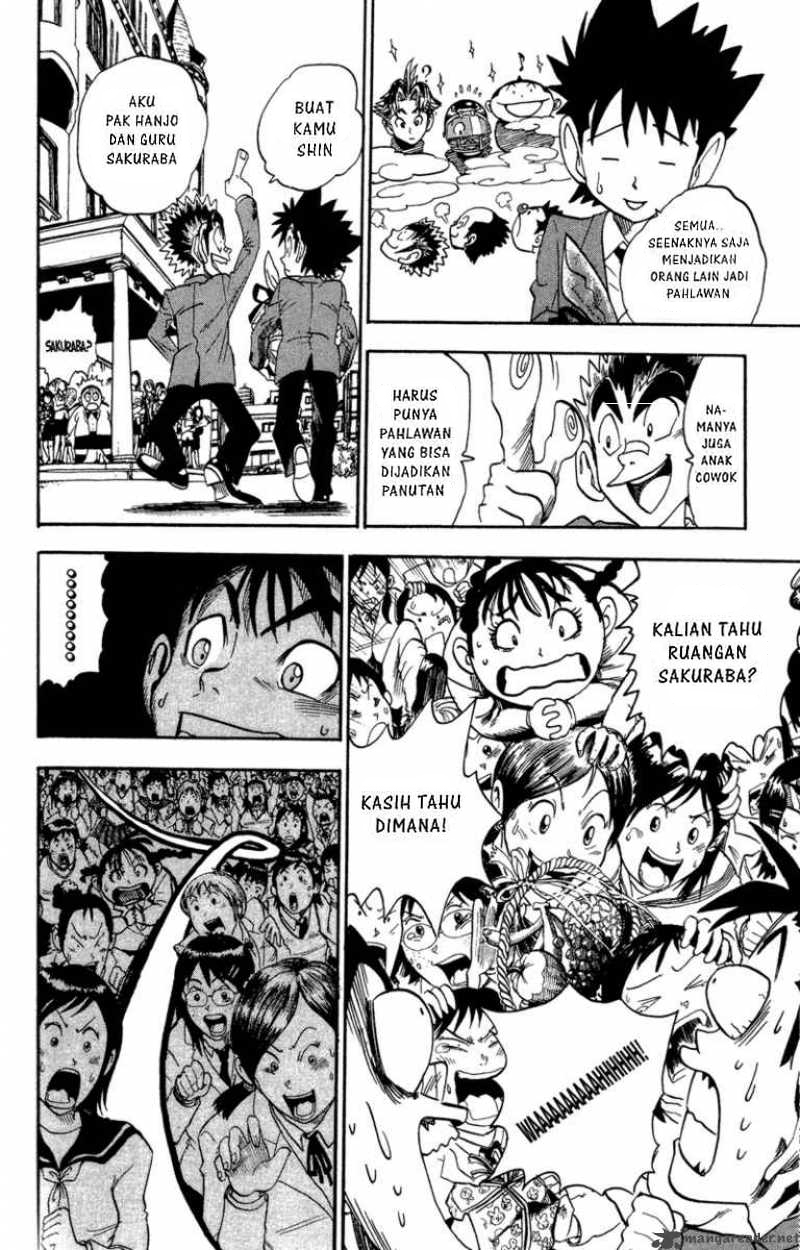
Manga Eyeshield 21 Chapter 146
Read Eyeshield 21 Chapter 333 online for free at MyReadingManga.us. You could read the latest and hottest Eyeshield 21 Chapter 333 in MyReadingManga. Read the topic about Have Eyeshield 21 Stopped?! On MyAnimeList, and join in the discussion on the largest online anime and manga database in the world! Join the online community, create your anime and manga list, read reviews, explore the forums, follow news, and so much more! (Topic ID: 17015).
See also:In Tokyo, a weak, unassertive boy named enters the high school of his choice—Deimon Private Senior High School. Sena's only remarkable physical abilities are his running speed and agility, which are noted by the school's American football team captain. Hiruma forces Sena to join the team as its.
To protect his identity from other teams who want to recruit him, Sena is forced to publicly assume the role of the team and enter the field under the pseudonym of 'Eyeshield 21' wearing a helmet with an to hide his features. The makeshift team initially takes part in the spring football tournament hoping to win through the strength of their new 'secret weapon'. However, the extremely weak team is eliminated early by the Ojo White Knights, one of the best football teams in Japan.After Deimon's defeat, the spring tournament is revealed as secondary in importance to the fall tournament, where the teams compete for the chance to play in the —the high school football league championship.
Hiruma, and Sena regroup and slowly build a real team from misfits and students looking to define themselves, such as —a baseball player who can only catch—and the. Other characters slowly join the team, and the series follows the building and growth of the Deimon Devil Bats and its members, and rival teams as they all strive to achieve their goal of playing in the Christmas Bowl.Some time after the Deimon Devil Bats win the Christmas Bowl and they become the best team in the country, Japan begins to gather the best football players to form a team to represent it at the American Football Youth World Championship, where a (MVP) will be awarded an contract and $3 million. Team Japan reaches the final against Team America, in which the game ends as a tie, and both teams are declared winners. Both teams are unsatisfied with this and return to the field for their own, improvised 'overtime', causing chaos with officials.
It is unclear which team wins the unofficial extra period, but Panther of Team America holds the MVP trophy aloft, winning the professional contract with the San Antonio Armadillos.The series concludes with Sena becoming the captain of the Devil Bats after Hiruma and Kurita leave school to attend college. In his final year of high school, Sena is invited to Notre Dame High School. In the final chapter, the main characters are in college or playing amateur-league football while employed.Production Before the series was published regularly, Riichiro Inagaki and Yusuke Murata published two called Eyeshield Part 1 ( 前編, Zenpen) and Part 2 ( 後編, Kōhen) on March 5 and 12, 2002 in.
When it would become a serial, the editorial department asked if Inagaki wanted to both write and draw the series, but Inagaki felt he was 'so rookie', so he asked Murata to be the illustrator. Before being asked to work on Eyeshield 21, Murata had read some of Inagaki's manga and noted that they 'had many cool design concepts of uniforms and equipment'.
He said, 'it could be turned into a great manga story' and he would 'be happy to take the challenge'; eventually he was chosen.During Eyeshield 21 's original run in the magazine, Inagaki went to the United States to see matches, and games. Despite having never played American football, Inagaki chose this theme after deciding that he wanted to create 'a protagonist that was wimpy at the beginning, yet could perform outstandingly in a sports game', and with this premise in mind he decided that American football would be 'a very suitable material.' When originally creating Eyeshield 21, Inagaki said he was wary because he did not want his manga becoming 'a simulator of football'. The fact that football is not a popular sport in Japan also worried Inagaki. As last resort, he thought to turn the series into a ' -style masked hero story' if it could not met the popularity required for the magazine. However, it was such a popular series that online commentators said that, considering the series' final length, the editors may have insisted that Eyeshield be kept going due to business reasons.
So my question is: can I update the servers' BIOS to the latest version without doing the full ELOM-to-ILOM migration, or will this not work (or even make the servers unusable)? Do BIOS versions and SP ones need to be matched, or can one be updated without bothering with the other?Bonus question: if this whole ELOM-to-ILOM thing actually is needed in order to update the BIOS, can that 2.0 CD-ROM be obtained without having a support contract with Sun/Oracle (which we are definitely not going to sign, being that quite old hardware)?Update:I tried upgrading only the BIOS on one of the servers, and it didn't boot anymore.  So it really looks like a full firmware upgrade is needed, and the management controller and BIOS versions should be kept in sync.So. But it looks like Sun (now Oracle) will happily let you download the latest firmware DVD (3.3.0), but it will not let you download the transition release (2.0) if you don't have a support contract.Well, I actuall don't care at all about the servers' management controllers (we don't even use them), so upgrading from ELOM to ILOM is totally irrelevant to me; but I need to update the servers' BIOS. Where can I find that.&!£%$% 2.0 CD-ROM?
However, Inagaki declared that the manga was 'exactly how he wanted to tell the story' and that Murata also seconded it. Media Manga.
Main article:The Eyeshield 21 manga series was written by Riichiro Inagaki, illustrated by Yusuke Murata, and originally serialized by Shueisha in the Japanese magazine Weekly Shōnen Jump from July 23, 2002 to June 15, 2009. The manga consists of 333 chapters spanning 37 (collected volumes), the first of which was released on December 20, 2002 and the last on October 2, 2010. Eyeshield 21 has also been published as part of the Shueisha Jump Remix series of magazine-style books. Fourteen volumes were released between June 28, 2010 and February 14, 2011. An English translation of the manga was published in North America by Viz Media under the Shonen Jump Advanced label between April 5, 2005 and October 4, 2011. The manga has also been licensed in some countries such as in France by, in Hong Kong by Culturecom, in Indonesia by, in Italy by, in South Korea by, and in Taiwan.
Original video animations. Main article:Two (OVA) based on the Eyeshield 21 manga series were developed. The first one, named The Phantom Golden Bowl, was developed by and shown as part of the Anime Tour on September 2003 and in Jump Festa 2004.
The second OVA, titled Eyeshield 21: Christmas Bowl e no Michi – Minami no Shima de Tokkun da! –, was shown at Jump Festa 2005. The two OVAs were later released on DVD; the first was released with the in a compilation called Jump Festa 2004 Super DVD.
The other was released by as an extra track on the sixth DVD of the Eyeshield 21 anime series. Television series. Main article:The Eyeshield 21 anime adaptation was co-produced by TV Tokyo, NAS, and Gallop, and was directed by until episode 103, and by from 104 to 145. The series of 145 television episodes aired in Japan from April 6, 2005 to March 19, 2008 on TV Tokyo. In Japan, Bandai Visual distributed the anime in DVD format; thirty-six volumes were released between July 26, 2006 and June 26, 2007.
Some changes were done in comparison to the manga; for example, swearings and guns or gambling references were reduced.Initially, Viz Media and planned to air a dubbed version of Eyeshield 21 on the internet video streaming service, and on NFL Rush site as a joint effort with (NFL). The anime was eventually posted only on Toonami Jetstream, with the first episode, which condensed three episodes, being available on December 17, 2007. However, it was not completed due to Toonami Jetstream's cancellation and shutdown.
In December 2008, the video streaming service Crunchyroll announced that it would begin to stream Eyeshield 21 subtitled on its site on January 2, 2009. The last episode was available on November 1, 2009 for premium users, and on March 7, 2010 for free users. On February 26, 2010, Section23 Films announced that Sentai Filmworks received the license to the anime. The first fifty-two episodes were released on four subtitled-only DVDs between May 18, 2010 and February 8, 2011. Audio The music for the Eyeshield 21 anime adaptation was composed.
The series use twelve pieces of theme music, five opening and seven ending themes. The opening themes are 'Breakthrough' and 'Innocence' by, 'Dang Dang' by, 'Blaze Line' by, and 'Honō no Running Back' by Short Leg Summer. The ending themes are 'Be Free' by Ricken's, 'Blaze Away' by, 'Goal' by, 'Run to Win' by, Koichi Nagano and, 'A day dreaming.' By Back-On, 'Flower' by Back-On, and 'Song of Power' by Short Leg Summer.A number of audio CDs linked to the anime series have been released in Japan. The original soundtrack was released on two discs by on March 5, 2008 under the title Eyeshield 21 Complete Best Album.
Three compilation albums, Eyeshield 21 Original Soundtrack Sound Field 1, Eyeshield 21 Sound Field Especial, and Eyeshield 21 Song Best, featuring opening and ending themes, insertion songs, and character and team songs were released on August 31, 2005, December 21, 2005, and March 23, 2006 respectively. Six containing have also been published. The first three, for Sena Kobayakawa, Mamori Anezaki, and Monta, were released on October 26, 2005. The other three, with the songs of Haruto Sakuraba, Seijurou Shin, and Suzuna Taki, were released on January 25, 2006. In addition to the musical CDs, Eyeshield 21 Drama Field 1, an CD, was released by Avex on September 21, 2005.
Video games Konami produced Eyeshield 21 games for Sony video game systems; it released Eyeshield 21: Let's Play American Football! For the on December 22, 2005 and Eyeshield 21: Portable Edition for the on March 2, 2006. Secured the rights to the Eyeshield 21 video game license for its systems in December 2004, releasing Eyeshield 21: Max Devil Power for the on February 2, 2006 and Eyeshield 21: Devilbats Devildays for the on April 6, 2006. Another game was scheduled for release on the, but it was later canceled. Nintendo published an Eyeshield 21 game for the, entitled Eyeshield 21: The Field's Greatest Warriors, which was released in Japan on March 8, 2007. Two non-football games, and, released for the Nintendo DS, have featured characters from the series. Various Devil Bats, Shin and Sakuraba from the White Knights appear in support cameos.
Print media Two art books based on Eyeshield 21 were released. The first, Eyeshield 21 Illustration Collection: Field of Colors, was published on November 2, 2006. The second, entitled Paint Jump: Art of Eyeshield 21, was released on December 19, 2008. Eyeshield 21 Official Databook: Chou Senshu Retsuden Ballers High, a databook, was published on October 4, 2005. A pair of were launched; the first, written by Katsumi Hasegawa, based on and named for the first OVA, was published on March 24, 2004. The second, Eyeshield 21: Netto no Hundred Game!, written by Eijima Jun, was published on May 26, 2006. The only original creator of the series who worked on these light novels was Murata, who illustrated them.
Other In Japan, jigsaw puzzles, action figures, plush dolls, calendars, key chains, and a machine were sold as merchandise for the series. Also released a series. Reception.
Retrieved October 27, 2017. Archived from on October 17, 2006. Retrieved September 12, 2019. 4 (2): 14–15.
February 2006. CS1 maint: untitled periodical. Author's Database/Original Work's List (in Japanese).
Jump J Books. Archived from on October 1, 2010. Inagaki, Riichiro; Murata, Yusuke (March 5, 2002). アイシールド21 前編 Eyeshield 21 Part 1. (in Japanese). (14): 143–178.
Inagaki, Riichiro; Murata, Yusuke (March 12, 2002). アイシールド21 後編 Eyeshield 21 Part 2. Weekly Shōnen Jump (in Japanese). Shueisha (15): 113–142. Inagaki, Riichiro (April 17, 2007).
(in Japanese). Archived from on April 8, 2009. Retrieved June 8, 2013.
^ Chang, Chih-Chieh (August 20, 2009). Anime News Network. From the original on May 6, 2014. Retrieved October 10, 2012. Inagaki, Riichiro; Murata, Yusuke (2006). Viz Media. Inagaki, Riichiro; Murata, Yusuke (2010).
Eyeshield 21, Volume 31. Viz Media. Inagaki, Riichiro (April 19, 2006). Play chart (in Japanese). Archived from on August 24, 2008. O'Mara, Sean; Schley, Matt (January 6, 2014). Sovereign Media.
From the original on May 6, 2014. Retrieved January 13, 2014.
Rattray, Tim (November 27, 2019). Anime News Network. Retrieved November 30, 2019. Inagaki, Riichiro; Murata, Yusuke (July 23, 2002). 黄金の脚を持つ男 The Boy With the Golden Legs. Weekly Shōnen Jump. Eyeshield 21 (in Japanese).
(34): 9–74. (in Japanese). June 15, 2009.
From the original on May 6, 2014. Retrieved February 23, 2014. Eyeshield 21 1 (in Japanese). From the original on September 24, 2012. Retrieved September 8, 2012. Eyeshield 21 37 (in Japanese). From the original on May 6, 2014.
Retrieved September 8, 2012. アイシールド21 1 (Shueisha Jump Remix) Eyeshield 21 1 (Shueisha Jump Remix) (in Japanese). アイシールド21 14 (Shueisha Jump Remix) Eyeshield 21 14 (Shueisha Jump Remix) (in Japanese). Macdonald, Christopher (December 20, 2004). Anime News Network.
From the original on May 6, 2014. Retrieved June 15, 2013. Archived from on September 15, 2010.
From the original on May 6, 2014. Retrieved June 15, 2013. (in Japanese). From the original on May 6, 2014. Retrieved February 18, 2014.
(PDF) (in Chinese). Hong Kong Comics and Animation Federation. Archived from (PDF) on February 15, 2014. (in Indonesian). Archived from on May 6, 2014. Retrieved February 18, 2014. (in Italian).
Archived from on January 4, 2014. Retrieved February 18, 2014.
(in Korean). Archived from on February 22, 2014.
Retrieved February 18, 2014. (in Chinese). Archived from on February 22, 2014. Retrieved February 18, 2014. From the original on May 6, 2014. Retrieved October 5, 2012.
^ (in Japanese). Archived from on July 1, 2013. (in Japanese).
Archived from on May 6, 2014. ^ (in Japanese). From the original on May 6, 2014. Retrieved October 22, 2012. ^ (in Japanese).
From the original on May 6, 2014. Retrieved October 22, 2012. Opening credits from the episodes:. '鉄壁のダブルストッパー'. Eyeshield 21.
Episode 103 (in Japanese). April 25, 2007. TV Tokyo. '一つ欠けたライン'. Eyeshield 21. Episode 104 (in Japanese).
TV Tokyo. 'みんなアメフトやろうぜ!' Eyeshield 21. Episode 145 (in Japanese). March 19, 2008.
TV Tokyo. (in Japanese).
From the original on May 6, 2014. Retrieved October 22, 2012. (in Japanese). From the original on May 6, 2014.
Retrieved October 22, 2012. Eyeshield Vol. 1 (in Japanese). Bandai Visual. Archived from on July 1, 2013. Retrieved October 5, 2012.
Eyeshield Vol. 36 (final volume) (in Japanese). Bandai Visual. Archived from on July 1, 2013. Retrieved October 5, 2012. ^ Homer, Chris (April 7, 2015).
The Fandom Post. From the original on October 27, 2016. Retrieved October 27, 2016. Anime News Network. June 19, 2007. From the original on June 21, 2007.
Retrieved April 28, 2013. ^ Loo, Egan.
Anime News Network. From the original on May 6, 2014. Retrieved April 29, 2013. Aoki, Deb. Archived from on May 6, 2014.
Retrieved April 29, 2013. Loo, Egan (June 17, 2009). Anime News Network. From the original on May 6, 2014. Retrieved June 15, 2013. Archived from on June 15, 2013. Retrieved June 15, 2013.
^ Loo, Egan (February 26, 2010). Anime News Network. From the original on May 6, 2014.
Retrieved April 29, 2013. Manry, Gia (February 9, 2011). Anime News Network. From the original on May 6, 2014. Retrieved June 15, 2013. ^ Staff & Cast.
Archived from on April 6, 2005. ^ Staff & Cast. Archived from on July 3, 2006. ^ Staff & Cast. Archived from on November 9, 2006.
^ Staff & Cast. Archived from on May 27, 2007. Staff & Cast. Archived from on July 26, 2005. Staff & Cast. Archived from on October 12, 2007. (in Japanese).
Hanshin Contents Link Corporation. From the original on May 6, 2014. Retrieved May 6, 2014.
From the original on May 6, 2014. Retrieved May 6, 2014. CDJournal (in Japanese).
Ongaku Shuppansha. From the original on May 6, 2014. Retrieved May 6, 2014. CDJapan (in Japanese). From the original on May 6, 2014.
Retrieved May 6, 2014. CDJournal (in Japanese). Ongaku Shuppansha. From the original on May 6, 2014. Retrieved May 6, 2014. CDJournal (in Japanese). Ongaku Shuppansha.
From the original on May 6, 2014. Retrieved May 6, 2014. CDJournal (in Japanese). Ongaku Shuppansha. From the original on May 6, 2014.
Retrieved May 6, 2014. CDJournal (in Japanese). Ongaku Shuppansha.
From the original on May 6, 2014. Retrieved May 6, 2014. CDJournal (in Japanese). Ongaku Shuppansha. From the original on May 6, 2014. Retrieved May 6, 2014. CDJournal (in Japanese).
Ongaku Shuppansha. From the original on May 6, 2014. Retrieved May 6, 2014. CDJournal (in Japanese). Ongaku Shuppansha. From the original on May 6, 2014.
Retrieved May 6, 2014. Eyeshield 21: Let's Play American Football! From the original on May 6, 2014. Retrieved September 12, 2012. Eyeshield 21: Portable Edition. From the original on May 6, 2014. Retrieved September 12, 2012.
^. December 23, 2004. From the original on May 6, 2014. Retrieved September 12, 2012. Eyeshield 21: Max Devil Power!. From the original on May 6, 2014. Retrieved September 12, 2012.
Eyeshield 21: Devilbatas Devildays. From the original on May 6, 2014. Retrieved September 12, 2012. Eyeshield 21 The Field's Greatest Warriors. From the original on May 6, 2014.
Retrieved September 16, 2012. (in Japanese). From the original on May 6, 2014. Retrieved September 12, 2012. ジャンプアルティメットスターズファーストアルティガイド. Pp. 167–169. Eyeshield 21 Illustration Collection: Field of Colors (in Japanese).
Archived from on August 12, 2007. Paint Jump: Art of Eyeshield 21 (in Japanese). Archived from on December 22, 2008. Eyeshield 21 Official Databook: Chou Senshu Retsuden Ballers High (in Japanese). Archived from on May 7, 2014. Eyeshield 21: The Phantom Golden Bowl (in Japanese). Archived from on May 7, 2014.
Eyeshield 21: Netto no Hundred Game! (in Japanese). Archived from on May 4, 2008. 108 Pieces Eyeshield 21: Sena and Hiruma 108-L105 (in Japanese).
From the original on May 7, 2014. Sugah, Hello (September 17, 2009). Live Journal. From the original on May 7, 2014.
Retrieved January 26, 2013. Archived from on May 7, 2014. Calendrier 2010/2011 Eyeshield 21 Calendar 2010/2011 Eyeshield 21. Archived from on May 7, 2014. Amusement Journal.
From the original on May 7, 2014. Retrieved January 26, 2013. Archived from on May 7, 2014. Archived from on May 7, 2014. (in Japanese). Archived from on August 6, 2004.
(in Japanese). Archived from on June 21, 2004. (in Japanese). Archived from on June 30, 2004. (in Japanese).
Archived from on April 23, 2004. (in Japanese). Archived from on June 20, 2004.
(in Japanese). Archived from on December 13, 2004. (in Japanese). Archived from on December 12, 2004. (in Japanese).
Archived from on November 26, 2004. (in Japanese). Archived from on May 27, 2005. (in Japanese). Archived from on March 19, 2005. (in Japanese).
Archived from on June 30, 2005. (in Japanese). Archived from on July 28, 2005. (in Japanese). Archived from on November 30, 2005.
(in Japanese). Archived from on December 21, 2005. (in Japanese). Archived from on June 17, 2006. June 14, 2006. From the original on May 8, 2014.
Retrieved September 15, 2012. (in Japanese).
Archived from on September 24, 2006. (in Japanese). Archived from on November 7, 2006. December 13, 2006.
From the original on November 2, 2016. Retrieved November 2, 2016.
December 22, 2006. From the original on November 2, 2016. Retrieved November 2, 2016.
Archived from on February 10, 2007. February 14, 2007.
From the original on November 2, 2016. Retrieved November 2, 2016. Loo, Egan (April 18, 2007).
Anime News Network. From the original on October 9, 2007. Retrieved November 1, 2016.
Loo, Egan (July 18, 2007). Anime News Network. From the original on August 20, 2007. Retrieved November 1, 2016. September 12, 2007.
From the original on November 2, 2016. Retrieved November 2, 2016. Loo, Egan (July 18, 2007). Anime News Network. From the original on November 16, 2007. Retrieved November 1, 2016.
Loo, Egan (February 22, 2008). Anime News Network. From the original on February 25, 2008. Retrieved November 1, 2016. Loo, Egan (April 15, 2008). Anime News Network.
Retrieved November 1, 2016. Loo, Egan (April 15, 2008). Anime News Network. Retrieved November 1, 2016. Loo, Egan (August 13, 2008).
Anime News Network. From the original on May 8, 2014. Retrieved September 15, 2012. Loo, Egan (November 19, 2008). Anime News Network.
Retrieved November 1, 2016. Loo, Egan (January 21, 2009). Anime News Network. Retrieved November 1, 2016. Loo, Egan (March 18, 2009). Anime News Network. Retrieved November 1, 2016.
Loo, Egan (May 13, 2009). Anime News Network. Retrieved November 1, 2016. Loo, Egan (August 12, 2009).
Anime News Network. Retrieved November 1, 2016. Loo, Egan (October 14, 2009). Anime News Network. Retrieved November 1, 2016. (in Japanese). June 15, 2009.
Archived from on June 18, 2009. March 17, 2009. From the original on May 8, 2014. Retrieved September 16, 2009. December 1, 2010. From the original on May 8, 2014.
Retrieved September 16, 2009. March 11, 2010. From the original on May 8, 2014. Retrieved February 22, 2014.
(in Japanese). October 23, 2011. From the original on October 28, 2011. Retrieved September 15, 2012. (in Japanese).
Archived from on May 8, 2014. (in Japanese). Archived from on November 4, 2011. (in Japanese). Archived from on December 10, 2007. (in Japanese). Video Research.
Archived from on January 10, 2008. (in Japanese). Video Research. Archived from on January 10, 2008. Macdonald, Christopher (October 13, 2006). Anime News Network.
From the original on August 3, 2014. Retrieved September 27, 2012.
Aoki, Deb. Archived from on May 8, 2014. Retrieved September 15, 2012. Nagatsuka, Kaz (August 2, 2006). From the original on May 8, 2014. Retrieved September 2, 2013.
Aoki, Deb (2007). Archived from on May 8, 2014. Retrieved December 13, 2008. Aoki, Deb (2008). Archived from on May 8, 2014. Pop Culture Shock. December 15, 2008.
Archived from on July 5, 2010. Zimmerman, Chris (March 31, 2010). Comic Book Bin. Retrieved April 26, 2017.Zimmerman, Chris (April 29, 2010). Comic Book Bin. Retrieved April 26, 2017.Zimmerman, Chris (November 1, 2010).
Comic Book Bin. Retrieved April 26, 2017.Zimmerman, Chris (November 8, 2010). Comic Book Bin.
Retrieved April 26, 2017. Campbell, Scott (October 2, 2008). Active Anime. Archived from on March 4, 2016. Pine, Jarred (October 23, 2005). Demand Media.
Archived from on February 27, 2014. Pine, Jarred (December 18, 2005).
Demand Media. Archived from on February 27, 2014. November 27, 2007.
Archived from on March 13, 2011. Bertschy, Zac (September 28, 2005). Anime News Network. From the original on May 8, 2014. Retrieved September 27, 2012.
Santos, Carlo (May 23, 2005). Anime News Network. From the original on May 8, 2014. Retrieved September 20, 2012. ^ Santos, Carlo (September 27, 2011).
Anime News Network. From the original on May 8, 2014. Retrieved September 27, 2012. Cooper, Bobby (May 11, 2010). Retrieved September 27, 2012. Cooper, Bobby (July 6, 2010). Internet Brands.
Retrieved September 27, 2012. Finnegan, Erin (September 6, 2010). Anime News Network.
From the original on May 8, 2014. Retrieved September 27, 2012. Finnegan, Erin (October 18, 2010). Anime News Network. From the original on May 8, 2014.
Retrieved September 27, 2012. Beveridge, Chris (December 21, 2010). Demand Media. Archived from on February 27, 2014.External links.
(in Japanese). (in Japanese). (manga) at 's encyclopedia. (1985–1987).
(1985–1987). Tekkamen wo oe! Dartanyan Monogatari Yori (1987). (1987–1989). (1988–1996).
Gaki Deka (1989–1990). (1989–1990). Tanken Gobrin Tou (1990–1991). (1991–1992).
(1992–1993). Dragon League (1993–1994). (1994–1995). Sorcerers of the Serenade: Secret of Top Record (1995–1996). (1995–1996). (1996–1997). (1996–1998).
(1996–2004). Anime TV de Hakken! Tamagotchi (1997–1998). (1998). (1998–present). Daichi wa Future Blade (2000–2002). (2000).
(2000–2004). (2002). (2004–2005). Morizo to Kikkoro (2004–2005). (2004–2008).
(2005–2006). (2005–2008). (2006). (2008–2011). (2009–2012).
(2011–2014). (2014–2017). (special) (2016).
(2017–2019). (2018–2019)OVAs.
Eyeshield 21 207 released! You are now reading online. If you are bored from Eyeshield 21 manga, you can try surprise me link at top of page or select another manga like Eyeshield 21 207 from our huge.
Eyeshield 21 207 released in manga panda fastest, recommend your friends to read Eyeshield 21 207 now! Tags: read Eyeshield 21 207 english, Eyeshield 21 207 raw manga, Eyeshield 21 207 online, Eyeshield 21 207 chap, Eyeshield 21 207 chapter, Eyeshield 21 207 high quality, Eyeshield 21 207 manga scan. Best regards;: #1 resource for Scans Online. Why You Should Read Online at mangapanda.vip?There are many reasons you should read Manga online, and if you are a fan of this unique storytelling style then learning about them is a must. One of the biggest reasons why you should read Manga online is the money it can save you. While there's nothing like actually holding a book in your hands, there's also no denying that the cost of those books can add up quickly.
So why not join the digital age and read Manga online? Another big reason to read Manga online is the huge amount of material that is available. When you go to a comic store or other book store their shelves are limited by the space that they have. When you go to an online site to read Manga those limitations don't exist.
So if you want the best selection and you also want to save money then reading Manga online should be an obvious choice for you©2017 mangapanda.vip, all rights reserved. Top speed, completely free.